Our class met with Laura Blaylock at the Tarrant Regional Water District Annex Building. This 26,000 square foot structure achieved LEED Gold certification in 2009, the first in the county.
Photo from Steele & Freeman
The Annex has one of the largest roof-mounted solar panel systems in Texas. With a 16 year payback, the system generates approximately 50-70% of the building's energy. They also received a rebate from Oncor for the installation of the system.
The cisterns are connected to a drip-irrigation system for landscaping, which features drough-resistant native plants. Outdoor lighting is also pointed down to prevent unnecessary uplighting.
Some sustainability features within the annex include local and recycled materials, no- or low-VOC paints, no-formaldehyde MDF cabinets in the breakroom, and Low-E glazing. The countertop in the breakroom as well as the exposed concrete floor here (right) are sealed with a beeswax product. Other flooring in the building includes cork and carpet tiles made from recycled materials. Additionally, the steel structure of the building contains 40% recycled content.
In addition, the TRWD serves almost 2 million people and so they are very dedicated to various water conservation programs.
Jerry is a project manager with experience in commercial leasing and ground-up construction. He works for the Cherokee Nation and is assigned to the Department of Homeland Security, Customs and Border Protection. At this position, he has worked on lawyer offices, forensic labs, border patrol offices, and on many other building projects. He discussed Energy Star, LEED, and Labs21, which is a voluntary program focused on improving the environmental quality of laboratories.
Jerry discussed his current task of standardizing office space planning for federal government buildings, an important issue considering the government does not want to expand their footprint. The federal government is looking to incorporate more teleworking within its various departments and this will definitely allow for space saving. He is determining the amount of office space needed for workers based on job descriptions, not on grade. He stated that 3,000 square feet of savings equates to $160,000 savings and 132 metric tons of CO2 are saved per year.
Here is a video about how teleworking is creating a more sustainable and efficient federal government.
The video below is the first 10 minutes of a great PBS special entitled "Greening the Federal Government." The full episode can be see here.
Our class met with Bill Peterson and Geoff Reiner, architects at Jacobs Engineering. They discussed adaptive reuse and as it relates to downtown Fort Worth. Adaptive reuse is the process of adapting/reusing an existing building for a different purpose. This process contributes to the preservation of greenspace, the lessening of sprawl, and the conservation of energy which is embodied in the existing structure. Reusing existing buildings for new purposes is not only sustainable but the method also adds to a rich history and sense of place for the community.
We started off at Fire Station No.1, an example of an adaptive reuse. The old firestation is now a museum, housing Fort Worth's 150 years of history. Here we discussed the evolution of design and construction of the city's built environment. At the beginning, the structures being built were simply a reaction to the elements. They were made from the wood found locally, and were designed to best optimize natural lighting, ventilation, and shading. As time went on, technology allowed for people to build with materials being transported in. And as technology introduced even more durable materials and attractive building systems, such as air conditioning, the built environment became less and less sustainable. Today, people are looking back at what has been built and are now asking the questions of how to be more sustainable, both with new construction and with the existing structures. The current status of downtown Fort Worth is a mixture of old and new, with wide sidewalks to accomodate pedestrians.
Here is an interesting video on challenges, opportunities and benefits of adaptive reuse.
Our class met with Shanna Cate, the Planning and Development Director for the Trinity River Vision Authority. From their website: "The Trinity River Vision Authority (TRVA) is the organization responsible for the implementation of the Trinity River Vision (TRV) - a master plan for the Trinity River in Fort Worth, Texas. It is underway now - connecting every neighborhood in the city to the Trinity River corridor with new recreational amenities, improved infrastructure, environmental enhancements and event programming. The TRV will create Trintiy Uptown, a vibrant urban waterfront neighborhood, expand Gateway Park into one of the largest urban-programmed parks in the nation and enhance the river corridor with over 90 user-requested projects along the Trinity Trails."
Citizens of Fort Worth have repeatedly stated that they want a waterfront and better access to the river. The city's current levee system, built after a devestating flood in 1949, is three stories high and has been a barrier to access. And as population and development increased, vast amounts of impervious surfaces have caused runoff and stormwater management problems for the river. The Trinity Uptown development will bring the public infrastructure needed to solve these issues.
Photo from TRVA
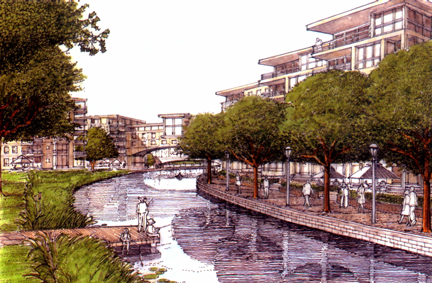
Trinity Uptown will include commerical development, boating and water activities, river walk and canals, riverfront dining and entertainment, a town lake and boardwalk, and higher learning.
Photo from TRVA
The Trinity River Vision project plans to be a model for sustainability as well. Through smart design and implementation, a sustainable community will result. One such way the vision plans to apply proper sustainability practices is by designing for density. By way of mixed-use zoning, the project will promote a live, work, play environment.
Photo from TRVA
Sustainability practices will also be implemented by focusing on elements that reflect good quality of life, such as canals, lakes, walking trails, public plazas, ball fields, and ecosystem restoration.
Photo from TRVA
Transportation is a big issue when it comes to sustainability. The circulation network designed will create an urban, walkable grid which will maximize the connectivity for vehicles, pedestrians, public transportation, and bicycles. The roads and bridges will be constructed to accommodate a future mass transit system. The waterways within the development will also be used for transportation purposes.
Another aspect of sustainability this project will entail is promoting good health. Twenty-seven miles of trails will be in place for recreational use. The usable waterways will be great for boaters, and new park facilities will be created so that the public can enjoy the outdoors.
Green building and sustainable contruction methods will be very important. Low-maintenance landscaping, reuse of materials for construction of public infrastructure, flood gates for water quality control, innovative storm water management, and incentives for construction of LEED certified buildings will be among the practices at Trinity Uptown.
Set for a 2021 completion date, the city, residents, and the TRVA are excited about what this development will bring to the city.
The revitalization of Gateway Park (left) will not only restore the park's ecosystem and provide quality flood control, but it is likely to spur economic development around the park. The park will be an important connection between the neighborhoods of the east and southeast of Fort Worth to the Trinity River.
Positive transformation of the Trinity River has already begun and proven to be what residents want. The ability to access the river adds to the city's sense of community.
DIY Urbanism, also known as Tactical Urbanism, is a pretty broad umbrella and can be done anywhere. I thought it was impressive that the concept even has its own Facebook page. Despite occurring in many places all over the world, the meaning is always the same - a short term action that leads to a long term change. The goal is to have a small-scale focus (building by building, block by block) rather than concentrating on large developments and master plans. Our government entities at all levels have little to no money for revitalization projects, while billions of dollars are spent on highways and wide roads only to lead to money and populations leaving the city. The change that is sought must be conducted by local residents and community groups.
This concept begins with old strategies of simply taking care of where we live and the neighborhoods we inhabit. By residents taking an active role in cleaning up their blocks, soon the community has a new spirit and the streets are enlivened with even more activity. People are taking back their cities in simple, yet creative ways. It's about grassroots plans and experimenting to see what works. Many examples of DIY Urbanism were discussed in Rik's presentation:
Photo from gray_matter(s) within Georgia Tech’s College of Architecture
"Parking Day" is occurring in many cities and gaining popularity. People take over metered parking spaces intended for cars and use however they please.
Called a Pedestrian Defense Movement in Mexico City, residents took it upon themselves to construct crosswalks using art. This is also occurring in cities all over the world. The public is painting their own crosswalks, bike lanes, and street signage.
Citizens are setting up their own free book exchange locations. Just another element to liven up the environment and create interaction within a city.
Depaving concrete areas has been made popular by the Portland group, Depave, who even provides instructional videos on their website. More natural community spaces are then created, such as gardens or landscaping. The asphalt is recycled as well.
"Pavement to Plaza" includes completely removing automobile access with temporary materials, only to transition to permanence later. Pedestrians are reclaiming space. This photo (right) is in lower Manhattan around 1997. The successful project was later constructed with permanent materials and became the inspiration for NYC's now widely-praised pavement to plaza program. One very well-know example was the Broadway pedestrian plaza experiment in Times Square.
Below is a successful demonstration of how something seemingly small but creative can really stimulate change. From The Fun Theory: "...the easiest way to change people's behaviour for the better is by making it fun to do."
***
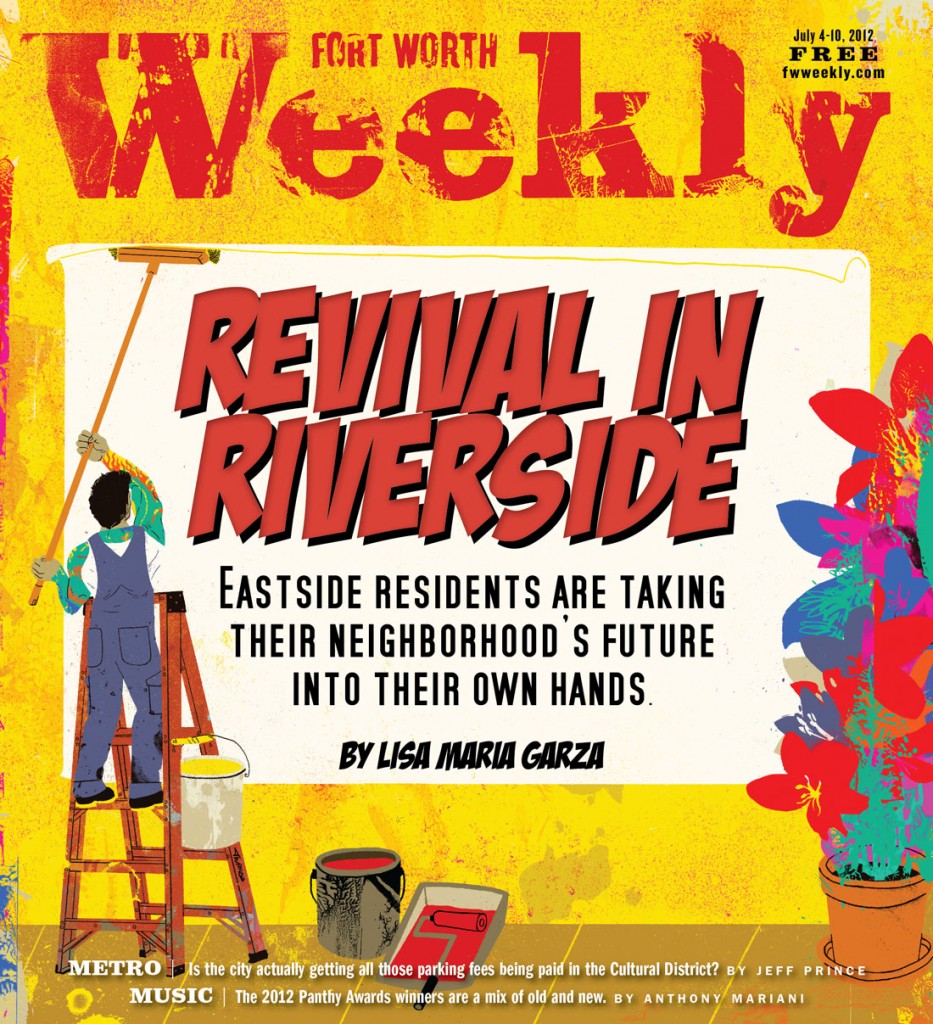
Debby Stein then spoke about her work with the Riverside Arts District in Fort Worth. Located northeast of downtown, this community is an urban village and has been designated for redevelopment by the City. Despite the creation of a master plan, nothing was really happening to further the vision. Debby has worked passionately with residents to bring attention and life to the area. From their website: "Riverside Arts District is the vision of artists, residents, community leaders, and business owners who want to build a walkable, dynamic and creative community in Fort Worth. RAD's first event was Better Block embRACE the STREET - a temporary yet dramatic makeover of Race Street including new streetscaping, public art, an urban garden, dog park, merchants, pop up shops and galleries. The event demonstrated the great potential of this neighborhood and the city's need for an authentic arts district. Upcoming events include Gallery Nights, Outdoor Concerts, Artist Open Studio nights, Garden events and more!" Debby has taken a lead role in understanding the area's potential and communicating and coordinating with local businesses, residents, developers, and city officials.
Art is the catalyst for this area on its path to revitalization. Through coordination of various demonstration projects, such as gallery walks and community drum circles, the Riverside Arts District is really creating an identity all its own and restoring the area one block at a time.
Mark Thompson is with Green Ox Energy, and he discussed renewable energy in Texas. In deregulated markets, such as DFW, the generation side of electricity, such as power plants, and electric providers are competitive markets. The distribution of the electricity, however, is still regulated.
In Texas, the big three in electricity generation have been coal, nuclear, and gas. There are many environmental concerns with these sources of energy, including greenhouse gas emissions, potential for natural disasters (like what we saw in Japan), and high water usage. Mark indicated that coal plants really are antiquated technology, and the EPA has so many restrictions on these plants that it is nearly impossible to building a new one. We have been seeing rising demand across the state and less supply to meet that demand, which is creating an opportunity for smart energy solutions.
The high cost of the above options versus the availability of traditional methods of electricity generation has hampered widespread use. Wind turbines are very large, expensive and locations are restricted since they need consistent wind generation. Similarly, geothermal can also be expensive and the heat pumps are only viable sources for heating and cooling. Green Ox Energy, conversely, has turned to solar energy for their central focus.
The video above features a project by Green Ox Energy, for which they installed a 7.56kW solar powered system and an 80 gallon solar powered water system which serves as a pre-heater for four additional 40 gallon electric tanks. The home is about 10,000 square feet and prior to the solar panel installation, the owner had electric bills that averaged $1,200 per month. The system is expected to generate over 10,000kW per year and produce almost $200,000 in utility savings over the life of the system. The customer sees a seven year payback for the system.
The elements of a solar panel system include the solar silicon cells, glass, frame, mounting hardware (for ground or roof installation) and the inverter for direct current (DC) to alternating current (AC) conversion. Systems are used for residential use, commercial use, or utility scale solar farms. The system design is important, which takes into account the orientation to the sun (south and southwest facing angles are most productive), the available space for panels, the possibility of shading, budget requirements, and available incentives.
Photo from Green Ox Energy
The panels are very strong and have little to no damage during high wind and hail storms. The expected lifespan of a panel is 25 years (the silicon does degrade over time due to sun exposure) but it will still produce electricity at 80% of its maximum capacity. The cost for solar panels has come down some due the improved technology. Currently, a typical 15 square foot panel can provide a 245 to 265 W output, and the efficiency is expected to ever-increase. And the system is designed so that an owner can expand it in the future.
The Botanical Research Institute of Texas (BRIT) is a $48 million LEED Platinum building, the first in Tarrant County and only the eighth in Texas. BRIT's mission reflects that of research, conservation and reusing natural resources. The organization studies plants in an effort to solve more global issues, such as pollution, hunger and water shortages. This 70,000 square foot structure seems to visually represent their mission.
The 5.2 acre site is restored prairie. The design and construction team demolished a health services building that sat on the north edge of the site, and restored over 76% of the site to natural habitat (the LEED requirement is 50%). And although demolition does not necessarily seem "sustainable" and "green," the team disassembled the building part-by-part, and almost 98% of the building was reused and recycled. This site also features low-maintenance native plants, and irrigation for the landscaping is supplied by rainwater cisterns as well as the retention pond. The pond collects rainwater and runoff from the parking lot and is designed to remove silt and pollution from the surface runoff water.
Photo from H3 Hardy Collaboration Architecture
The vegetative roof is also a major feature of the building. The living roof supports the local ecosystem, helps to insulate the building, limits rainwater runoff, and is durable.
The 51.87 kilowatt (kW) solar photovoltaic panels are installed on the roof of the Archive Block (see image below). The 285 panel system covers 5,943 square feet and meets approximately 16% of the building's annual electric demand (a savings of about $37,000 per year). The remainder of the roof is a white, reflective surface. Other site features, as seen in the image below, include LED parking lot lighting, low-emissions vehicle parking, and the location of the 166 geothermal wells which supply a majority of the building's heating and cooling.
Photo from BRIT
Photo from Beck. Aerial Photography, Inc.
The design of the building is very important, especially when speaking to energy efficiency. The photo (left) is facing north. The tilt-up concrete walls shield much of the eastern, western and southern exposures. The vast amount of windows on the north side of the building allow for great natural light without the heat gain from direct sunlight. The strategic placement of windows allow access to light and views.
Photo from H3 Hardy Collaboration Architecture
Natural sunlight penetrates more than 75 percent of the building.
The interior of the building features many recycled and sustainable materials, such as bamboo ceiling (seen in the above photo of the office space), linen and paper wall coverings, wool carpet, recycled rubber flooring, and recycled sheetrock was used for ceiling tiles and gypsum board. Materials with recycled content were used for over 20% of the building materials in this project. Structural steel, steel pipes and other metal products are some of the most significant recycled content materials at BRIT. And the cypress wood that is cladding for the wall (right) at the entrance lobby actually fell from logging barges more than 100 years ago and was reclaimed and produced into panels.
BRIT also features low-flow plumbing features, low VOC paints and flooring, wall insulation that is made from sand and post-consumer recycled glass bottles, and staff that mostly bike to work.






.jpg)